Jim & Marian Jordan of “Fibber McGee and Molly”
by Albert H. Morehead (c. 1946)
----------------------
If you are a typical American, on some Tuesday night during the last eight or ten years you tuned in on a radio show known as Fibber McGee and Molly, you listened and laughed and enjoyed yourself, and you have been tuning In more or less regularly ever since.
So much is a matter of statistics. There is a pocket sized cardboard chart known as the Hooper rating (and sometimes called the radio man’s "bible") which measures the relative popularity of radio shows from week to week. In the last several years the McGees have been playing see saw with Jack Benny and Bob Hope for the highest spot, with Fibber and Molly most often on the upswing.
Equally clear, even if it isn’t a matter of statistics, is the reason why you listen and why you laugh. We all love to hear ourselves talk, and the McGees talk even as you and I. Fibber strives as valiantly as any American husband to be wise, masterful and important. Molly, loyal and patient, still manages to deflate his ego as neatly as any American wife. The unseen audience snickers at hearing its own foibles in make believe, when they don’t hurt.
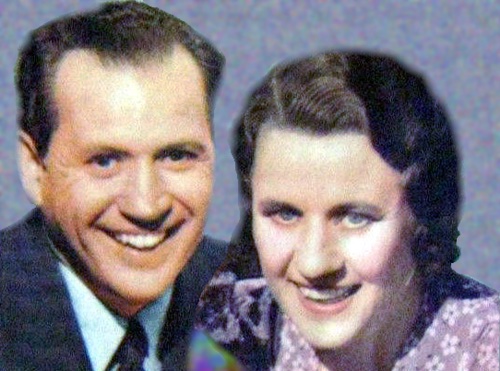
The McGees know how to do It. In the eyes of the Bureau of Vital Statistic and the United States Census, they are merely a married couple named Jim and Marian Jordan, respectively forty nine and forty eight years old, with two married children and one grandchild. They live in a small town, are solid members of the community, land owners and taxpayers, and Jim Jordan can talk himself out of a parking ticket far better in his home town than can Fibber McGee on the air.
Today the Jordans are at the top, but this exalted position is a relatively recent development in a twenty eight-year life together which has been just as hectic and eventful (though not always so comical) as that of the McGees whom they now portray. Starting with a war marriage much like the marriages of millions of young Americans in the last four years, the Jordans on the way up went through about as much as any young couple of 1946 would want to face.
When you meet the Jordans you see precisely the same people you would have met in the years when they were struggling upward but hadn’t yet arrived. Jim Jordan is a man of medium height and build, with greying hair which has receded somewhat at the temples. Marian Jordan has blue eyes and brown hair and is very pretty; she could (but doesn’t) complain that her photographs never do her justice.
Both Jordans are quiet dressers and wholly inconspicuous in a crowd, so that they manage to attend theatres and restaurants without creating the stir which would result If they were recognized. This is quite a delightful matter to the Jordans, who are small town products and publicity shy.
Even more does conversation with the Jordans reveal the how and why of their eventual arrival at the top. A chat with them brings out a wealth of humorous situations in which they have found themselves in twenty eight years of married life. There’s a difference in the telling; Marian sparkles, while Jim is a more typical comedian and introduces an anecdote without even a twinkle in his grey eyes. The humor may be of a joyous nature when the incident had a happy ending, and a bit wry if it was temporarily annoying, but every experience seems funny later and that’s the test.
Just as an example you might take one of the Jordans’ moving days, twenty years ago.
Jim and Marian were already on the radio, which was then in its infancy. They occupied a first floor apartment in a three story house; they had daughter Kathryn, five, and son Jim Junior, two, and furniture and a grand piano (not paid for); they had a weekly broadcast and a sponsor and they made ten dollars a week.
“We were six months behind in the rent,” Jim recalls, “and then one day the landlord came to see us.”
“He told us he had a tenant who wanted to take the entire first floor,” says Marian, “and you know what we thought was coming. And then he asked us, very apologetically, if we’d mind moving to the third floor."
The Jordans couldn’t afford to hire moving men, so all their friends rallied ‘round. It was easy to move most of the furniture but the grand piano was another matter.
"Altogether there were eleven men,” Marian recounts, “and they all got under that piano. They staggered up to the first landing and there they stuck. The piano couldn’t be budged, one way or the other.
“So my brother went around the corner and found two professional moving men, having lunch. They came in, just the two of then, and took the piano up to the third floor without any trouble at all.”
It couldn’t have seemed very funny to the toiling Jordans at the time, but you can bet people chuckled when they heard something like it over the airwaves years later; for of such stuff is the Fibber McGee and Molly program built. All of which brings up a third reason for the success of Fibber and Molly.
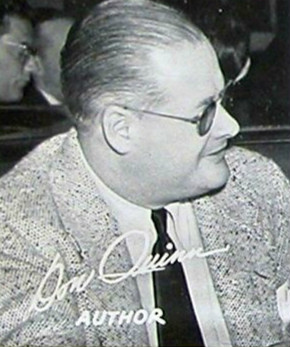
The name of this reason is Don Quinn. He is a jolly, 200 pound ex cartoonist who has been writing the Jordans’ scripts since 1931, including the first McGee show in 1935 and every one of them since. Jim and Marian and Don are a three way partnership (Jim’s comment being, “We’re the only couple I know that has three members”) and an enduring one, having lasted out the years when the Quinn Jordan comedy formula was by no means proved.
This formula is one that does not depend on gags for its laughs. The success of every broadcast is based solidly on the belief that if the situation is intrinsically humorous, the result will be a good time for everyone. No one’s feelings get hurt when Fibber and Molly are on the air; there are jibes, but always good natured ones.
Equally important are the catch phrases which Quinn sprinkles throughout his scripts — not so often as to seen repetitious, but often enough to become remembered. Such things as “Heavenly Days!" and “‘Tain’t funny, McGee,” and “Here we go again.” And, especially, the fabulous McGee domicile at 79 Wistful Vista. “You know what that means?” inquires Marian. “It means the outlook isn’t so good.” As for the street, “Don just happened to hit those keys on his typewriter.” Since that early broadcast on which Fibber and Molly won their house in a raffle, 79 Wistful Vista has become better known to most Americans than any other street address in the world, including 1600 Pennsylvania Avenue (the White House) and 10 Downing Street (the British Prime Minister’s residence) put together.
Not only the Quinn Jordan partnership but the entire working of their show is legendary in the radio world by virtue of its utter absence of friction. An overwrought atmosphere is traditional in radio conferences and rehearsals. Ulcers caused by nervous strain are notoriously an occupational disease of the industry. As many as thirty two people have been known to mix it in discussing a script amid loud and angry arguments. Within this frantic world the Jordans and their company move serenely, never more than five or six people at their meetings, always a calm atmosphere, never an angry word. (“You and I argue,” Marian points out. “Yes, but we don’t shout,” Jim rejoins.)
The smooth, unhurried workings of the McGee troupe is all the more remarkable when one considers that every show is prepared almost at the last minute. They often have an idea or two in reserve. but never a script. Yet they have on occasion tossed out an entire script the day before their broadcast, whereupon Don Quinn sat down and wrote another one and nobody acted scared.
Every Tuesday’s broadcast begins around the middle of the previous week. The inner circle consists of the Jordans, Quinn, Phil Leslie (his assistant), Cecil Underwood (representing the advertising agency), and in recent months Andy White, another assistant to Quinn. Ideas are likely to occur to any member of the group and are passed around by telephone and adopted or rejected as food for further discussion. Leslie’s job is to write a two page memorandum on two or three such ideas before the group first meets on Friday or Saturday.
At this first meeting the ideas are kicked around and one is selected for the next broadcast. There is always another meeting at the Jordans’ house on Sunday, at which time Quinn may and may not have written a script for the first “bit” (each broadcast is divided into three bits). If he has, it is read; Jim and Marian read their own parts, and Don reads all the others with great expression and as nearly as possible in the voices of the actors who will finally play then. The rest of the show having been planned in the course of this session, Don goes home to write it.
“He can write the whole script in an evening,” remarks Jim Jordan, marveling; but sometimes the word “evening” Is an elastic term and stretches into the following morning. The fact remains that when the Jordans, their supporting cast, Billy Mills and the orchestra and all the others show up at Hollywood’s Radio City on Monday morning, Don Quinn and the script are there too. Further changes are made both in Monday’s workout and in the dress rehearsal on Tuesday morning, but by two o’clock Tuesday afternoon the script is final and there is no more to do until they go on the air that night. Tuesday afternoon is usually spent sitting around and thinking of new ideas for future shows.
In rehearsal, Jim Jordan appears nervous; this is perhaps due to his inability to remain still for long, so that he walks around between his cues. Actually, he has a most philosophical attitude toward the show and his job. “When it’s all over, you’d always think of things you could have improved, anyway," he says. “So I always say to myself, if it isn’t perfect this week, maybe it will be next week.” The fact that Marian and Don join in this philosophy is evidenced by the unprecedented stability of the Fibber and Molly show. They have the same sponsor (Johnson’s Wax), the same advertising agency (Needham, Louis and Brorby), the same announcer (Harley Wilcox) with whom they started eleven years ago.
The calmness of the Jordans in their profession may stem from their philosophical approach to life in general and to their marriage in particular. In this approach there may be a lesson for some worried young Americans today. For Marian Jordan once found herself in the same boat as the much pitied “war bride” of today, married one day, parted by war the next. Back In 1918, the Jordans had scarcely five days of married life before Jim was off to the western front of World War I, and demobilization did not reunite them for a year after that.
At this point it must be recorded that seventeen year old Jim Jordan first met sixteen year old Marian Driscoll at choir practice in their home town of Peoria, Illinois. This item of Jordan family history will cause Jim Jordan to wince, if he reads this. “I happened to mention that to somebody twelve years ago,” Jim says regretfully, "and it’s been in everything that’s been written about Marian and me over since. It’s true enough, but it begins to sound awfully corny when you’ve been hearing it for twelve years.”
Jim Jordan grew up and became a clerk in a drug house; Marian was a piano teacher with twenty three pupils. They wanted to get married, but there was the war. However, Jim had tried to enlist and had been refused, and his next door neighbor was a member of the draft board and assured him that the war would be over so soon that he was in no danger of being drafted. So the Jordans were married on August 31, 1918, and went off on a honeymoon.
“We got our big wedding present on September fifth,” Marian relates. “It said, ‘Greetings.’" Jim’s neighbor had been right about one thing: The war was soon over, but so was Jim — overseas.
Marian’s recipe for enduring her solitary life was simple: Keep busy. Her piano pupils increased in number to fifty five. She increased her church work because that was where she had met Jim, and being there made her feel closer to him.
The months passed, and a troop transport landed Jim in Canada. “The first thing I did was buy a big can of apricots,” says Jim. “I went behind a billboard and ate them all.” The next thing he did was return unexpectedly to Peoria, where he sneaked in on Marian in the kitchen and kissed her so hard it made her lip bleed. And since then the Jordans have had twenty seven years of married happiness.
“They’ve gone overboard on this problem of the returning soldier,” Jim opines. “Sure they’ll have problems. All married people have problems.”
“It’s just a matter of patience,” Marian adds, “and you need that anyway. The boy has changed, but so has the girl. Changes won’t matter if they love each other.”
To top off their long separation, Jim and Marian found themselves in a position which disturbs some people but didn’t bother them.
"We lived with Jim’s mother,” says Marian. “She was a remarkable woman and helped us a lot. Jim and I would have our quarrels, but she would always call me aside and say, ‘Keep calm. It’ll work out.’ And it always did."
Nevertheless, the Jordans were a happy couple when they first moved into a house all their own. It was a very modest one, and even so they couldn’t afford it. During their first two years, Jim had a series of ten or twelve jobs — postman, door to door salesman, clerk in a grocery store, everything but actor. Marian explains it: “I thought at the time it was just a run of hard luck, but now I know better. Jim was just trying to stay out of show business, when that was where he belonged all the time.” Jim finally succumbed and he and Marian went into vaudeville. For several years after that, when their efforts to make a living from radio would leave them in the hole, their recourse would be to take a vaudeville tour, get themselves back on their feet, pay all their back debts — and then to radio again. It was a precarious routine for a long time, but it finally clicked.
It may have been the vaudeville experience that turned Jim and Marian Jordan into the home loving couple they are today. Vaudevillians were troupers; they traveled. “In those days there was no such thing as being in show business and living at home,” according to Jim. “The only exception was a big star who could live in New York. We weren’t ready for that.” So, once having a home, the Jordans clung to it. When they first made their big radio success, they refused to part with the modest house in Chicago where they had lived through thinner times. “We have the same friends as always,” they said. *We can live in the same place."
Today Jim and Marian live in Encino, California, a small town (you won’t find it on your map) about a dozen miles from Hollywood. Don Quinn lives two or three blocks away. The Jordans have made themselves a part of their community, and Jim served two terms as president of the Encino Chamber of Commerce.
Being home lovers, the Jordans are two rare stay at homes. They like it, and besides they have their hobbies. Jim likes to read and to collect books and, especially, to do cabinet making in his basement shop. He makes furniture that looks wholly professional. (He also made a barbecue wagon three feet wide and then found that he couldn’t get it over a bridge two feet wide that led to the outdoor kitchen. Maybe that wasn’t a natural for a Fibber McGee script.)
Marian likes to sew and knows her way around a kitchen; she insists that you can predict the success of a marriage from looking at the kitchen. This opinion was revealed when Marian was boasting about her daughter Kathryn, now Mrs. Adrian Goodman, whose daughter Diane made the Jordan grandparents last year. (The Goodmans’ house is in Encino, too.)
"She has everything she needs for a first class kitchen,” Marian boasts. “You can always tell from that. If a wife is bound to make a home, she’ll fix up her kitchen first.
"Jim and I wanted to hire a couple not long ago and we saw one that seemed all right but they had no start at all toward a home. I said, ‘Jim, we’d better not hire them. I’m afraid their marriage won’t last.’"
Jim Jr. is married now, too. Following in the parental footsteps, he is a radio and motion picture actor, and he and his wife live in a Los Angeles apartment. So (real estate note) the Jordans’ Encino house is for sale. Three bedrooms have become too many.
In the meantime the Jordans won’t lack for a place to rest their heads. Several years ago, they bought a 1,000 acre ranch about 140 miles from Encino, and they have added to it parcel by parcel until it now has 4,000 acres, all well stocked with Black Angus cattle. Jim made a serious study of his new job and is reputed to be a first class cattle rancher, which makes him prouder than compliments on his radio show. He is also proud of a prize steer he had in a livestock show three years ago, and a prize heifer he had last year.
The ranch is already the Jordans’ “week end” haven (their week end begins Wednesday morning, when they drive down, and ends Friday night or Saturday morning, when they drive back to Encino and the first conference on their next show).
In these off periods Jim and Marian try not to talk shop, though a good idea will be spoken out whenever it occurs to one of them. In discussing ideas or dialogues, however, they are one hundred percent impersonal. You won’t hear “You say this and then I say that,” or even “Fibber says this and then Molly says that.” It’s “the man says,” and “the woman says.” Fibber McGee and Molly are just characters in an act. Jim and Marian Jordan are real people.